About
Alzheimer’s disease is a debilitating neurodegenerative disorder that slowly destroys brain function, leading to cognitive decline, behavioral and psychological symptoms, and failure of critical life-sustaining functions. Advanced stages of AD/ADRD deprive individuals of their sense of self, their memories and independence, their emotional and financial well-being, and ultimately, their lives. The societal impacts of AD/ADRD, including the effects on families and the enormous health and long-term care costs, are likely to grow with an aging population in the United States. AD/ADRD affects more than six million Americans and one in ten people (10.9%) aged 65 and older. As AD/ADRD occurs primarily among older adults, the number of individuals with AD/ADRD is projected to double to 13 million by 2060. The total cost of health care for people with AD/ADRD in the United States in 2024 is estimated to be $360 billion.
Common Data Elements (CDEs) are metadata standards serving as a foundation for semantic interoperability, a prerequisite for leveraging disparate Real-World Data (RWD) sources for secondary analysis. Existing efforts in AD-related metadata development include the National Alzheimer’s Coordinating Center’s (NACC) Uniform Data Set and NINDS CDEs. These are parts of an important metadata collection for AD/ADRD research, but existing CDEs are not designed, developed, and sufficiently validated to transform NIA-funded studies through the generation of Real-World Evidence (RWE) from RWD with data linkage and longitudinal analyses.
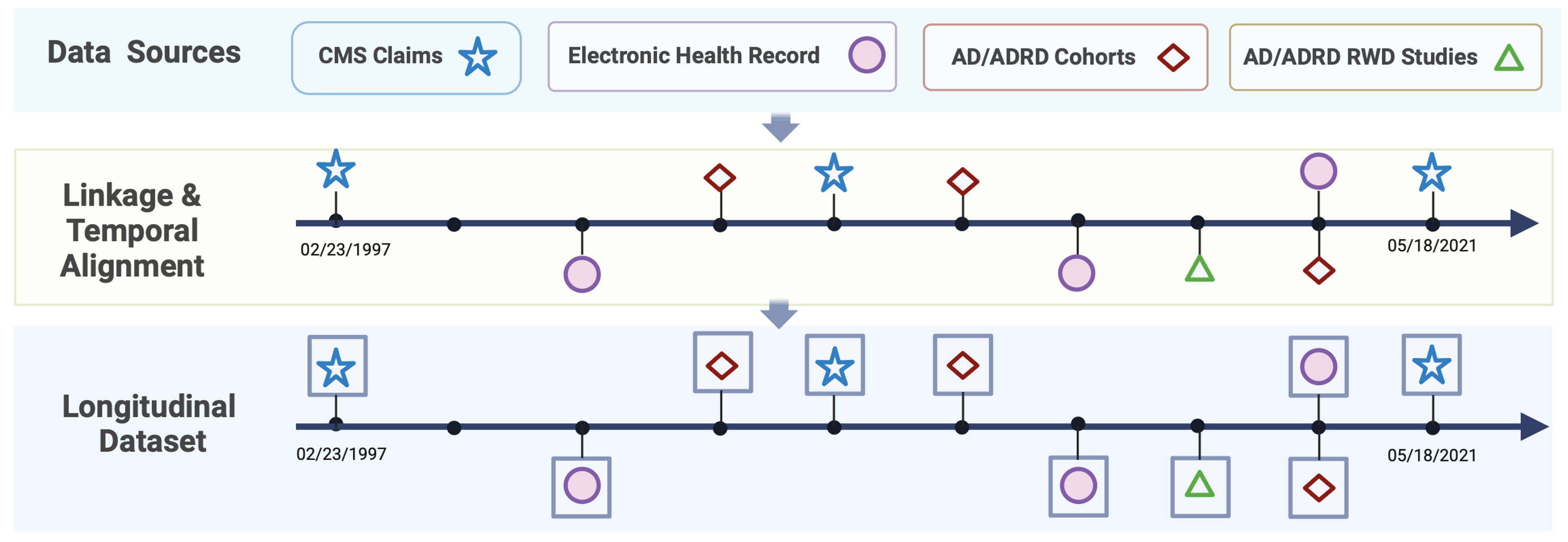
The goal of ReCARDO is to develop CDEs for NIA-funded studies on AD/ADRD using RWD from electronic health records and claims data from Centers for Medicare & Medicaid Services (CMS). The CDEs will foster data harmonization and interoperability across and among NIA studies that involve disparate and unaligned data fields. Ultimately, ReCARDO may enable researchers to utilize studies data and RWD more efficiently and produce RWE in a timely manner with longitudinal data from NIA-funded studies and RWD.
High-level Overview of Two Data Harmonization Phases: Temporal Alignment and Semantic Alignment (with AD-CDEs)